Diving fins — the complete guide
The fin decides
how far one breath
takes you.
Seven fin families, forty-three models, from a short snorkelling blade to a competition carbon fin — explained by the people who mould them. Work out which one is yours in about two minutes, then go straight to the model.
Fin finder
Tell us how you dive. We'll tell you which blade.
Fin choice is decided by three things, in this order: what you do underwater, whether you wear boots, and how much leg you have to drive the blade. Start with the first one.
The seven fin families
Not all fins are "just fins".
A snorkelling fin and a competition carbon blade are as different as a bicycle and a motorbike. Pick the family that matches your diving — each one opens a full guide with every model, sizing advice and the trade-offs nobody puts on the box.
 01 / Full foot
Full foot fins
Closed pocket worn on bare feet or thin socks. Lighter, simpler and far easier to pack — but sizing has to be right, because there's no strap to adjust.
7 models · Nautilus Snorkeling, FLEXA, SPIDER, Legend and more
Full foot guide 02 / Open heel
Fins with strap
The standard scuba configuration. An adjustable heel strap takes neoprene boots of any thickness, from soft travel blades to stiff high-thrust paddles for current.
8 models · Forza cinque, POWER, NAUTILUS, Nemo and more
Open-heel guide 03 / Technical
Technical diving fins
Stiff rubber blades on stainless spring straps, sized for drysuit rock boots. Built around frog kick, back kick and helicopter turns rather than flutter speed.
9 models · Rubber Fins III & IV, Diva, Retta, Omega
Technical guide 04 / One piece
One-piece long fins
Blade and pocket moulded as one unit. Nothing to loosen, nothing to maintain, and the lowest entry price into real long-blade propulsion.
9 models · X-Race line, Lunga stealth, Long fins with strap
One-piece guide 05 / Detachable
Detachable plastic blades
The blade unbolts from the pocket, so you replace a damaged blade instead of the whole fin — and swap length or stiffness as your technique develops.
5 models · HF 100 black / camou / clear, X-Race detachable
Detachable guide
06 / Composite
Carbon & fiberglass
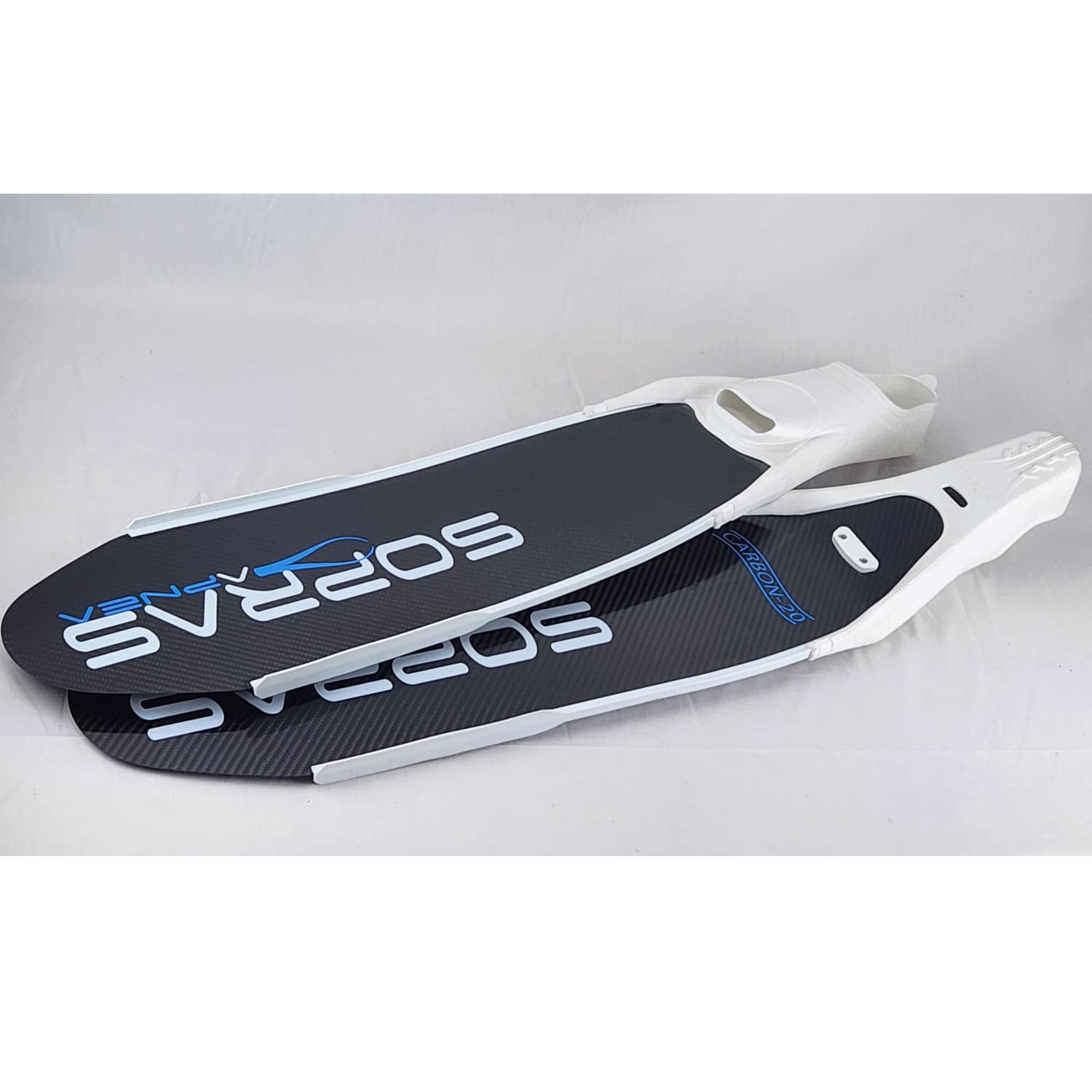
Where fins stop being equipment and start being performance. A composite blade returns energy in a clean snap instead of losing it — more depth on the same breath.
4 models · HF 400, HF 300, HF 200 camo, Carbon Fins detach
Composite guide 07 / Monofin
Monofins
Both feet, one wide blade, whole-body dolphin kick. The most efficient tool in freediving and the most demanding to learn — and useless for anything else.
1 model · Sopras Monofin
Monofin guide Start here
How to choose diving fins
The full buying guide: discipline, foot pocket, blade length, stiffness and material — in the order that actually decides which fin you should own.
Covers all 43 models across every family
Read the buying guideSide by side
Seven families, one table
The honest version — including what each fin family is bad at.
| Fin family | Worn with | Best at | Weak at | Typical buyer |
|---|---|---|---|---|
| Full foot | Bare feet / thin socks | Snorkelling, warm water, packing light | Cold water, precise sizingNo strap to adjust | Holiday diver, snorkeller |
| Open heel | Neoprene boots 3–7 mm | All-round recreational scuba | Bulk in luggage | Certified recreational diver |
| Technical | Rock boots, thick booties | Frog, back and helicopter kicks | Long-distance flutter speed | Tech, cave, wreck, pro |
| One-piece long | Neoprene socks | Value, simplicity, learning | No blade replacementDamage means a new fin | New freediver, spearo |
| Detachable plastic | Neoprene socks | Durability plus upgrade path | Fixing needs checking | Progressing freediver |
| Carbon / fiberglass | Neoprene socks | Maximum efficiency per kick | Fragility, price | Depth & distance diver |
| Monofin | Neoprene socks | Straight-line efficiency | Manoeuvrability, versatilityCannot be walked in | Competitive freediver |
Blade materials
Plastic, fiberglass, carbon — what you actually gain
A long fin stores energy as the blade loads and releases it as it springs back. How much of that energy comes back is a material property, and it's the biggest single performance variable in a freediving fin.
| Material | Energy return | Durability | Weight | Buy it if |
|---|---|---|---|---|
| Plastic | Usable, damped | Excellent — survives knocks | Heaviest | You're learning, on a budget, or diving off rocks |
| Fiberglass | Very good | Good — forgiving of point loads | Medium | It's your first composite, or you spearfish |
| Carbon | Best — crisp, quick | Fragile — cracks on impact | Lightest | You dive often and your technique is established |
The stiffness rule almost everyone gets wrong
Stiffness is not a quality ranking — it's a match to the diver. A heavier or more powerful diver collapses a soft blade past its efficient range; a lighter diver never loads a hard blade enough to make it give the energy back. Caught between two grades, take the softer one. A slightly soft blade still returns energy; an under-loaded stiff blade just wastes effort and tires you out.
Where to buy
Three shops, one manufacturer
Sopras is an Italian brand built by Diveproduction s.r.o. in the Czech Republic. Each shop covers one discipline — go straight to the one that matches your diving.
Sopras Sub
Recreational and sport scuba. Full foot and open-heel fins, masks, snorkels and the rest of the ABC range.
Shop SoprasSub
Sopras Apnea
Freediving and spearfishing. Long blades in plastic, fiberglass and carbon, detachable systems and monofins.
Shop Sopras Apnea
Sopras Tek
Technical and professional diving. Rubber blade fins with stainless spring straps, drysuits and doubles kit.
Shop SoprasTekQuestions divers actually ask
Fin FAQ
What size diving fins should I buy?
Size open-heel fins while wearing the dive boots you'll use — the pocket should grip the boot across its width without pinching, and the strap should hold the heel flat on the pocket floor. Size full foot fins by EU shoe size with about a thumb's width between your longest toe and the end of the pocket, adding half a size if you'll wear a neoprene sock. Freediving fins are always sized over the sock you actually dive in.
What is the difference between open heel and full foot fins?
Open-heel fins have an adjustable strap and are worn with neoprene dive boots, which makes them the standard for cold and temperate water and for technical diving. Full foot fins have a closed pocket worn on bare feet or thin socks, which makes them lighter and more compact but limits them to warm water — below roughly 24 °C most divers find bare-foot diving uncomfortable over a 45–60 minute dive.
Are stiffer fins better?
No. A stiff blade you cannot drive through its full flex range on every kick delivers less usable thrust than a softer blade you can cycle efficiently, because fatigue cuts your kick frequency and duration. Match blade stiffness to your leg strength, body weight and diving environment. If you're choosing between two stiffness grades, the softer one is usually the safer bet.
Is carbon worth it over fiberglass?
For divers who dive regularly and have established technique, yes — carbon is lighter and returns energy more crisply, and you feel it on every kick. For newer divers, tighter budgets, or diving in contact-prone environments, fiberglass delivers most of the benefit at a lower price with significantly better durability. Carbon's advantage over good fiberglass is real but incremental; its fragility and cost are also real.
Can I use a monofin for spearfishing or recreational diving?
No. A monofin has almost no manoeuvrability — you can't turn quickly, hover, change direction precisely or work near structure — and it can't be walked in at the surface. It's a specialist tool for dynamic apnea, constant-weight depth and finswimming. Spearfishing and recreational diving need bi-fins.
How should I store and care for diving fins?
Rinse with fresh water after every salt dive, including inside the foot pocket and through any strap buckle, working the release several times. Dry the pocket completely and store fins flat or hanging — never standing on the blade tips or with gear stacked on top, which causes permanent tip curl. Keep blades out of direct sunlight and never leave them in a closed car in summer.
The journal
Longer reads on fins and finning
Technique, gear testing and the physics of a kick cycle — written by people who make blades for a living.
How to choose diving fins: the complete guide
Discipline, boots, blade length and stiffness — in the order that actually matters.
Read the guide →Open heel or full foot? Choosing your foot pocket
Water temperature, luggage limits and the sizing mistakes that cause blisters.
Read the guide →Carbon vs fiberglass vs plastic freediving blades
Energy return, fragility and the honest cost-per-dive of a carbon blade.
Read the guide →Five finning mistakes that waste your air
Bicycle kick, pointed toes, over-stiff blades and three more fixable habits.
Read the guide →Fin maintenance: making a blade last a decade
Rinsing, UV, storage geometry and the one inspection point that matters.
Read the guide →Monofin or bi-fins? Choosing your discipline first
Why the most efficient fin in freediving makes most divers slower at first.
Read the guide →Still not sure which blade is yours?
Tell us how and where you dive and we'll point you at the right model — no upsell, and no, we won't sell you carbon if fiberglass is the better fin for you.