Carbon vs fiberglass vs plastic freediving blades
Carbon fins are the most over-recommended purchase in freediving. They are also, for the right diver, the single biggest performance upgrade available. Both of those things are true, and which one applies to you comes down to how a blade stores and returns energy — and how much of that return you can actually use.
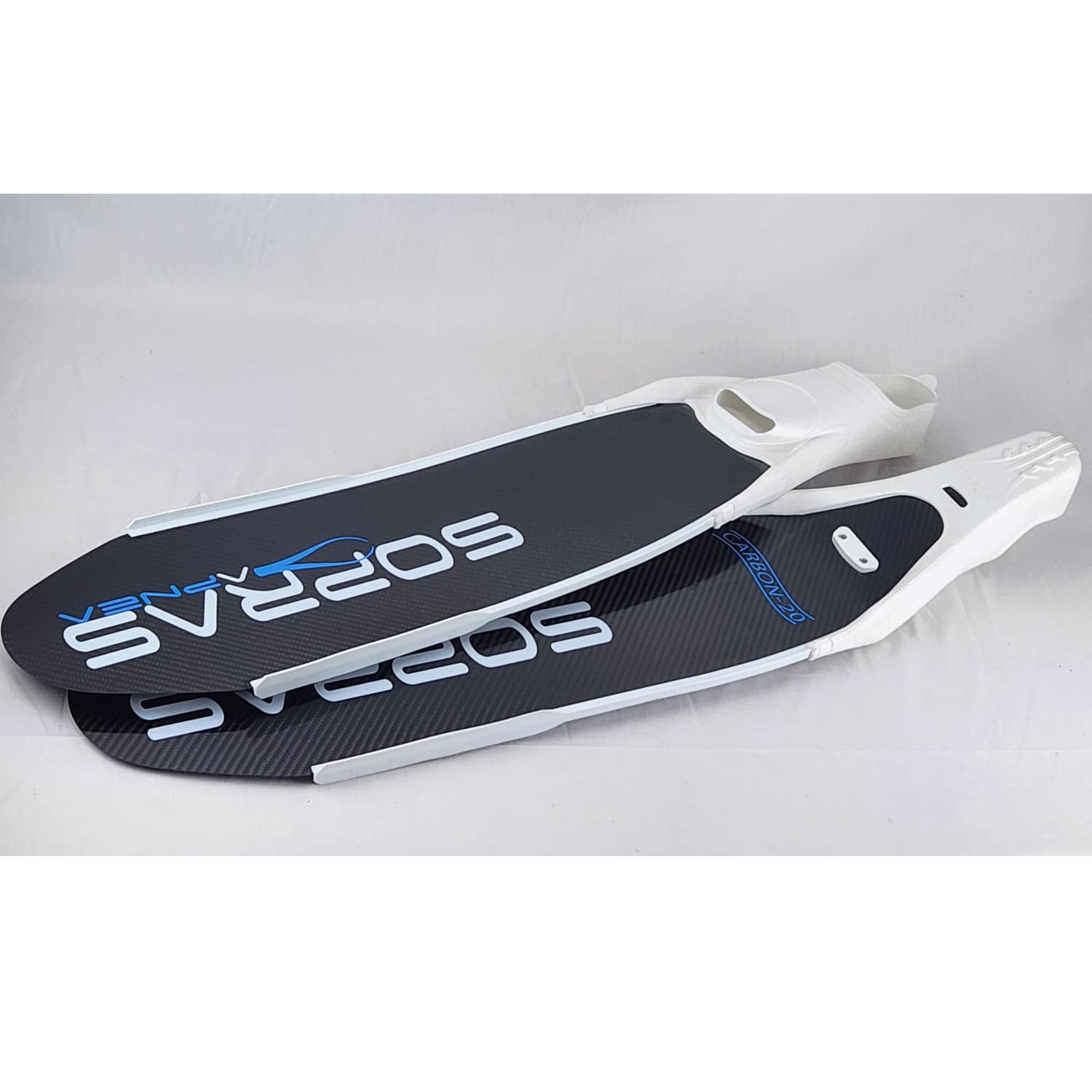
The short version
- A long fin is a spring. Material decides how much of the energy you put in comes back out.
- Plastic returns the least and survives the most. Carbon returns the most and breaks the easiest.
- Fiberglass sits close to carbon in performance and close to plastic in toughness — which is why it's the smart first composite.
- Stiffness matched to your body weight matters more than material. A wrong-stiffness carbon blade is slower than a right-stiffness plastic one.
- Most carbon blades die in transport, not in the water.
On this page
A fin is a spring
On the down-stroke your leg loads the blade and it bends. That bending stores energy. As the blade straightens, it releases that energy against the water and pushes you forward.
No material returns all of it. Some is lost inside the material itself as it flexes — converted to heat, essentially wasted. How much gets lost is a property of the material, and it is the entire reason this debate exists.
That's also why the difference is most obvious when you're tired. Fresh, you can muscle through an inefficient blade. On the fifth dive of a session, or at the end of a 75-metre dynamic, the energy the blade gives back is the energy you're still moving on.
Plastic: the honest starting point
Technopolymer blades damp a noticeable share of what you put in. You feel it as a blade that bends willingly but returns lazily — propulsion without snap.
What you get in exchange is genuine toughness. A plastic blade shrugs off a rocky entry, a boat deck, a tank dropped on it in the back of a car. It doesn't crack when a wave slams you into a ledge. It costs a fraction of a composite.
For anyone learning the technique, this is the right blade, and not as a compromise. Early freediving technique involves a lot of inefficient kicking, and a forgiving blade that survives contact is more useful than a responsive one you're afraid to take anywhere.
Plastic deserves more credit than it gets A diver with good technique on plastic blades will comfortably out-dive a diver with poor technique on carbon. Technique is the bigger variable by a wide margin, and plastic lets you build it without worrying about the equipment.
Fiberglass: the one most divers should buy
Glass fibre in a resin matrix behaves much more like a true spring. The return is quicker and crisper, and the difference from plastic is immediately obvious on the first dive — more distance per kick at the same effort.
Crucially, fiberglass is also forgiving. It tolerates point loads and knocks that would crack carbon, and when it does fail it tends to delaminate progressively rather than snap. You can take fiberglass blades places you would not take carbon.
This is why fiberglass is the right first composite for most people, and why camo fiberglass blades are the default among spearfishers — they work around rock, boats and kelp, where a carbon blade is a liability.

Carbon: what you're really paying for
Carbon fibre has the highest stiffness-to-weight ratio of the three and the lowest internal damping. The blade is lighter, so less of your energy goes into simply moving the fin through the water, and the return is faster and cleaner.
An experienced freediver feels this immediately — the blade snaps rather than pushes, and the same depth costs fewer, easier kicks. Over a training session the reduction in lactic build-up is the part people notice most.
The cost is fragility, and it's not a marketing caveat. Carbon is strong in the direction it's engineered for and weak against point loads and impacts. A carbon blade can survive years of diving and then crack because someone set a weight belt on it. Repairs are rarely economical.
Buy carbon when your technique has stopped improving faster than your equipment. Before that, the blade isn't what's limiting you.
Stiffness matters more than material
This is the part that gets skipped, and it causes more disappointment than any material choice.
Stiffness is not a quality ranking. It's a match between the blade and the diver driving it. A heavier or more powerful diver on a soft blade bends it past its efficient range — the blade collapses and the energy goes sideways instead of backwards. A lighter diver on a hard blade never loads it enough to make it spring back at all, and ends up pushing a stiff board through the water.
- Soft suits lighter divers, pool work and high-cadence technique.
- Medium is the all-round choice for most depth freedivers and the right default if you're unsure.
- Hard suits heavier or heavily weighted divers with strong legs and established technique.
And the rule that saves people money: when you're between two grades, take the softer one. A slightly soft blade still returns energy on every kick. An under-loaded stiff blade returns almost nothing and tires you out doing it.
Wetsuit thickness and weighting shift this too. A 7 mm suit with the lead to match makes you effectively heavier and pushes you toward a stiffer blade than the same diver in a 3 mm would want.
Ready to move to composite? Four carbon and fiberglass models, with hardness options.
Composite fins guide Plastic bladesThe honest cost per dive
Carbon looks expensive until you divide by use, and then it depends entirely on how often you dive.
A diver training twice a week gets hundreds of sessions out of a set of blades, and the per-dive cost of carbon becomes trivial next to travel and course fees. A diver who freedives on two holidays a year will put perhaps thirty sessions on the same blades — and the carbon tax per dive is enormous, for a benefit they're not yet equipped to use.
There's a second factor people underestimate: a detachable system changes the maths. If the blade bolts onto the foot pocket rather than being moulded into it, a cracked blade costs you a blade, not a pair of fins. It also means you can start on plastic and upgrade the blade later while keeping the pocket you've already sized correctly.
Keeping a composite blade alive
Most carbon blades are destroyed on land. Specifically, in car boots.
- Use a fin bag with rigid or well-padded blade protection, not a soft tube.
- Never stack gear on top of blades. A weight belt on a carbon blade is the classic way to end its life.
- Never step on a blade, even in sand. Point loads are what carbon fails against.
- Rinse with fresh water and dry out of direct sun. UV degrades the resin over years.
- Store flat or hanging — never standing on the tips, which sets a permanent curl.
- Check the blade-to-pocket junction every season. That's where stress concentrates and where cracks start.
Which one is yours
Three honest recommendations, in the order most divers should pass through them.
- Learning, on a budget, or diving off rock: plastic, on a detachable pocket so you have somewhere to go later.
- Diving regularly, technique coming together, want a real jump: fiberglass, medium stiffness. This is where most people get the best value in the whole sport.
- Training seriously, chasing depth or distance, technique established: carbon, stiffness matched to your weight and suit, with a bag that protects it.
And if none of those quite describes you, the safe choice is fiberglass in medium. It is very hard to regret, which is more than can be said for a carbon blade bought two seasons early.
Written by the team at Sopras, who build plastic, fiberglass and carbon blades in-house. If you tell us your weight, suit thickness and what you're training for, we'll tell you which hardness to take — email [email protected].